US MIDTERMS · PREVIEW
2026 US midterm elections preview
A look at the scenarios for Congress, their potential market implications and the lessons from previous midterms.
435 House seats, 35 Senate seats and 36 governorships are on the ballot.
Voters across the US head to the polls on 3 November 2026 for the midterm elections. All 435 House seats, as well as 35 Senate seats, and 36 Governorships are up for grabs, with the vote being seen as something of a referendum on how both President Trump, and the GOP, have handled key issues, at roughly the halfway mark in Trump’s term.
State of Play
At present, the Republicans (aka, the GOP) have a majority in both the Senate, and the House of Representatives, though the House majority is a slim one, holding just a 4-seat advantage over the Democrats. Nevertheless, with the GOP in control of both chambers, President Trump has thus far faced relatively little by way of Congressional opposition to his agenda.
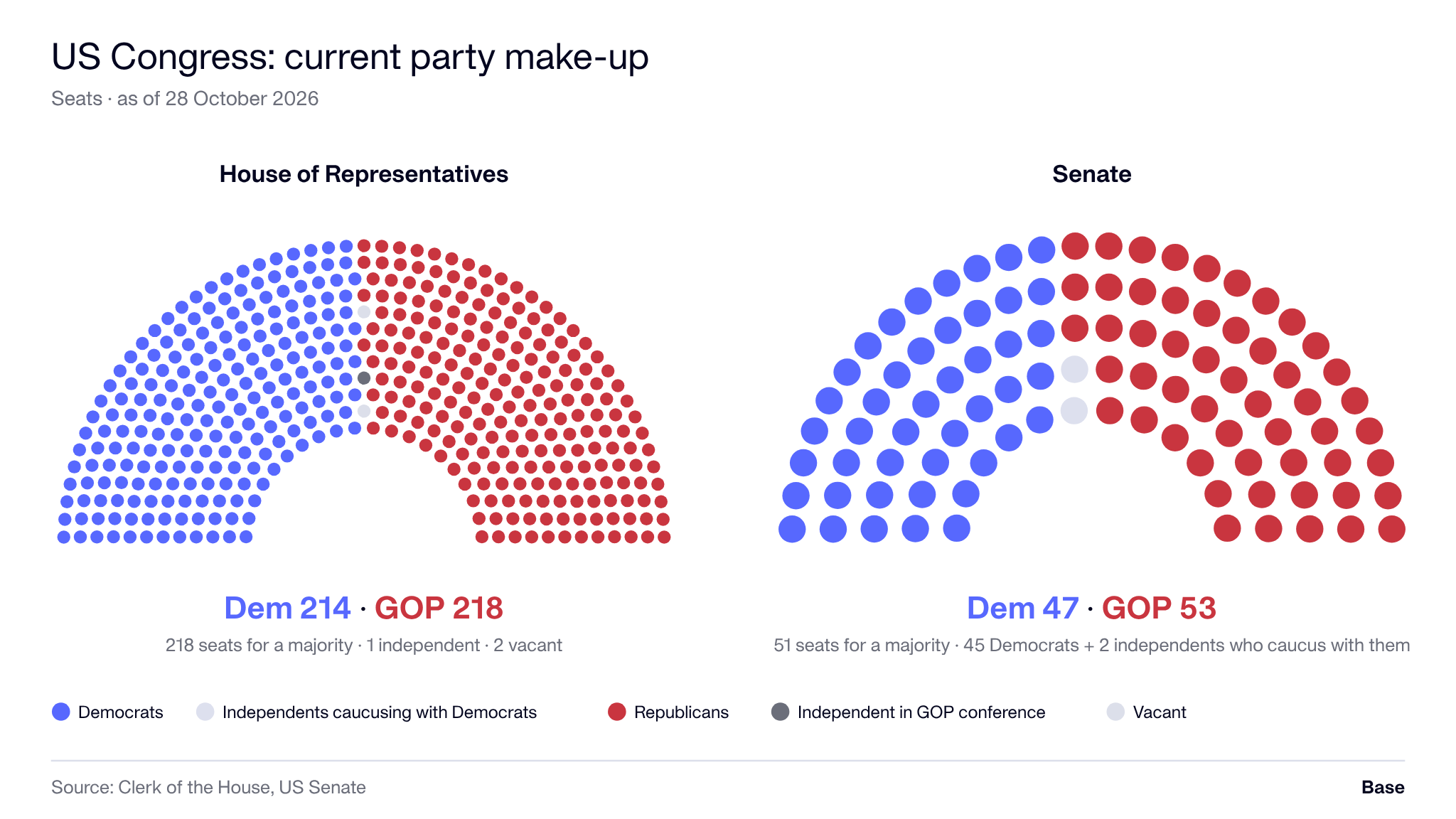
Added to which, of the 36 states holding Gubernatorial elections, there is presently an even split between Democratic- and Republican-held states. While, perhaps, not attracting as much attention as races for seats in Washington, these state-level elections take on extra importance this cycle, particularly with decisions regarding AI infrastructure, and the ongoing data centre buildout, sitting in the hands of state governors, and with many candidates having pushed for stricter rules surrounding the construction of new data centres.
Key Issues
While the data centre buildout is an important theme, it is the ongoing rise in the ‘cost of living’ that is likely to dominate at the ballot box.
Inflation remains a key concern for Americans, with headline CPI having risen to 3.7% YoY in September, largely reflecting a substantial increase in gasoline and diesel prices as a result of the US-Iran conflict, as well as the ongoing Russia-Ukraine war. In particular, lower-income households have been particularly exposed, not only to the ~40% YoY rise in the national average gasoline price, which now tops $4 per gallon, but also the surge in mortgage rates, with the average 30-year fixed mortgage rate standing at 7.32% in Freddie Mac’s 22 October survey, after 7.40% the previous week.
Meanwhile, in addition to inflation, geopolitics remains a key issue at the ballot box. While the US-Iran conflict would ordinarily be seen as a foreign policy issue, the aforementioned surge in prices, largely as a result of significant disruption to commodity flows through the Strait of Hormuz, has seen the conflict morph into much more of a political issue. Support for military action has continued to dwindle in recent months, with a recent Reuters poll noting that just under a third of Americans continue to support military action, close to the lowest level since the conflict began.
Furthermore, healthcare is likely to be a defining issue come election day, after enhanced subsidies under the Affordable Care Act expired at the end of last year, resulting in many experiencing a substantial increase in the cost of healthcare. AI, as mentioned, is also a key factor, not only so far as the data centre buildout, and associated stress on local infrastructure, is concerned, but also considering the impact that AI adoption is having on the labour market, which remains in a state of ‘slow hiring, slow firing’. Tariffs, and immigration, two cornerstones of Trump’s presidential campaign in 2024, are also likely to feature heavily in the upcoming midterms.
Scenarios
Put simply, at a Congressional level, the midterms can produce one of four possible results. A ‘sweep’ would see the same party obtain a majority in both chambers, as the GOP currently does, while a ‘divided congress’ would see one party control the House, and the other controls the Senate.
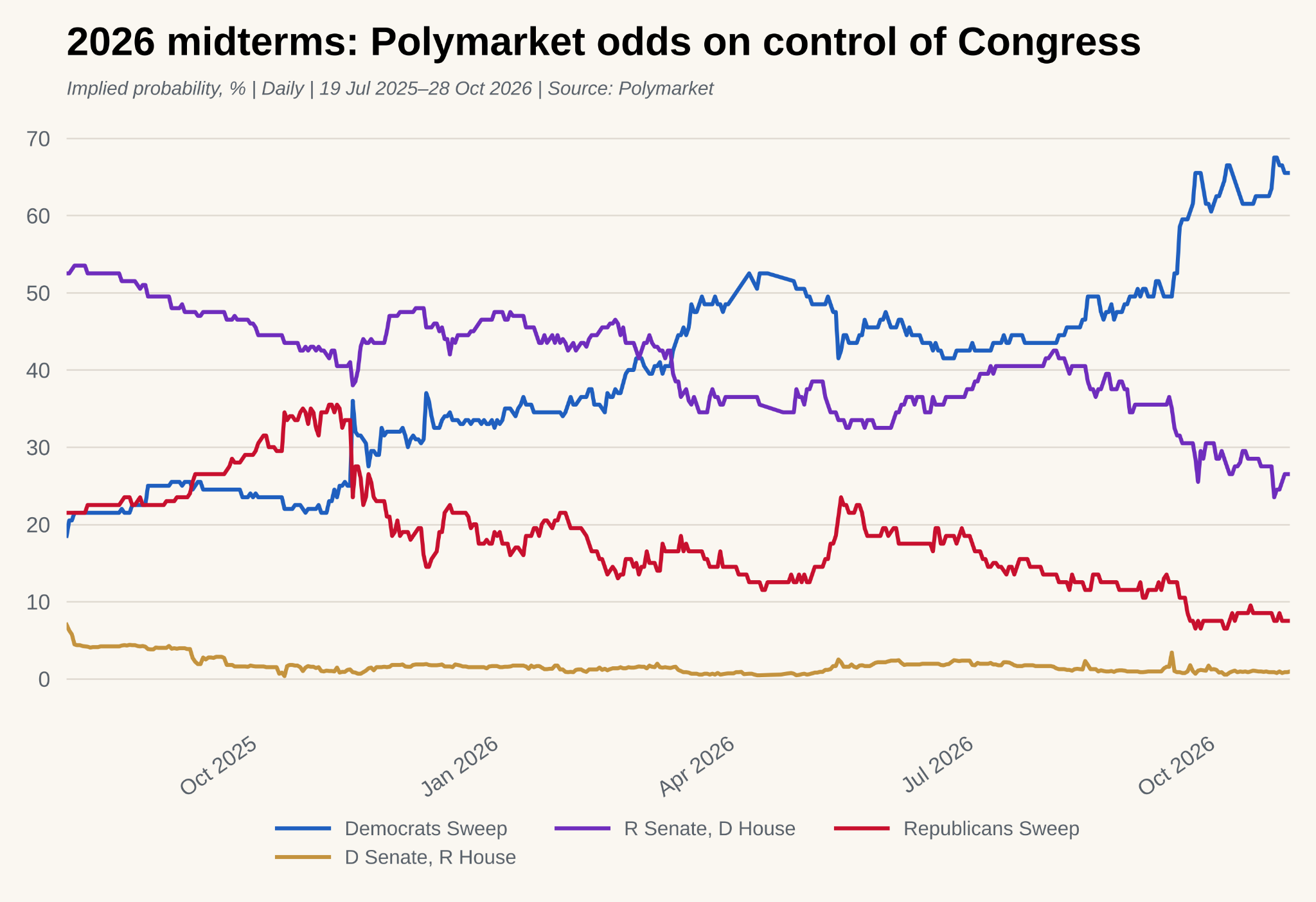
At the 28 October snapshot, prediction markets favour a Democratic sweep as the most likely outcome, seeing around a 2-in-3 chance of such a result. The GOP’s prospects of holding onto the House majority are viewed as low, though the Senate map does appear somewhat more favourable for the incumbents.
For financial markets, the potential implications of the most likely scenarios are as follows:
Three outcomes to watch
Most likely
Democrats win both chambers
Prediction markets: around 2 in 3 (28 Oct)
- Equities
- Could dip first, tech-led
- US dollar
- Could soften
- Treasuries
- Yields could fall
Divided Congress
Republican Senate, Democratic House
- Equities
- Could be supportive
- US dollar
- Could benefit
- Treasuries
- Price gains could be capped
Less likely
Republicans win both chambers
- Equities
- Most upside potential
- US dollar
- Could rally
- Treasuries
- Yields could rise
Democratic sweep: A knee-jerk dip in risk assets could be led by megacap tech, as participants worry that a tougher stance on AI companies could be on the cards, with equity downside amplified by the significant concentration of these names in benchmark equity indices. The US dollar could soften and Treasury yields fall as the chances of another reconciliation bill, and with it significant additional Treasury supply, diminish substantially. The deregulation agenda could slow considerably amid increased Congressional oversight, while delays to Medicaid and SNAP cuts could support growth in the short term. Latin American currencies could face headwinds given likely higher scrutiny of Trump’s relationship with the region.
Republican Senate, Democratic House: Arguably a “goldilocks” scenario for risk assets if the current baseline economic outlook remains in place, leaving growth robust for the most part, and the AI buildout on track. The US dollar could benefit from a return to the “US exceptionalism” theme, though upside in Treasury prices could be capped as funding needs remain largely unchanged from present. Longer-term risks could increase around possible government shutdowns and debt-ceiling standoffs, given Congressional gridlock.
Republican sweep: Unlikely, but the most bullish equity scenario in this framework, as the “AI trade” could extend its gains into 2027 while legislative and infrastructure risks recede. Treasury prices could fall and the yield curve steepen as the prospect of another reconciliation bill increases. The US dollar could rally on yield differentials and firmer growth expectations.
These are conditional market scenarios, not predictions. The initial reaction may depend on how far the outcome differs from what markets have already priced in. Over longer periods, growth, inflation, monetary policy and earnings also matter.
The historical comparison below shows positive average 12-month S&P 500 returns under all four congressional outcomes in this sample. It does not establish that the election result caused those returns. Two groups contain only two elections each, so the averages should be read as context rather than a guide to the next outcome.
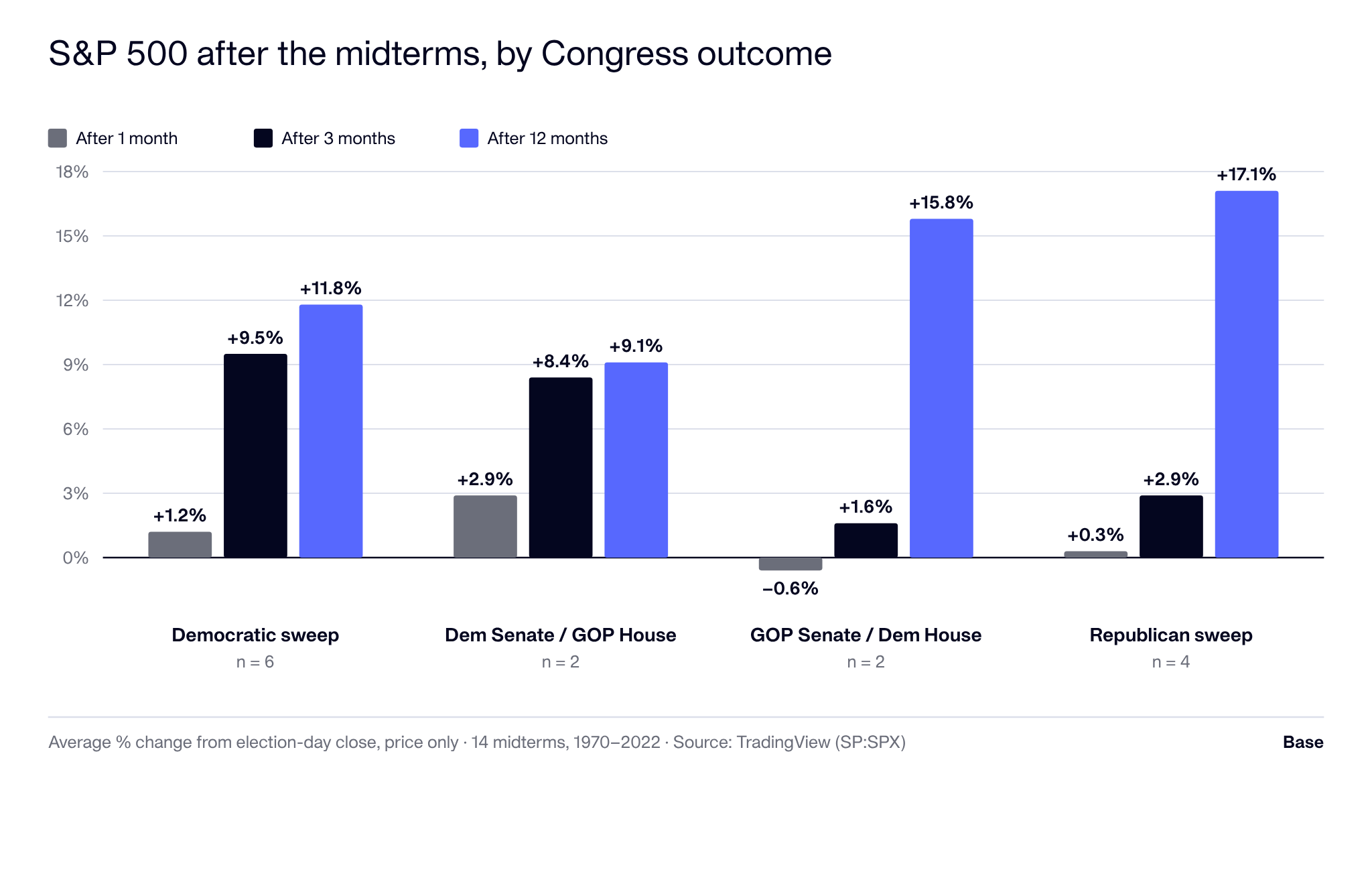
| Outcome | Elections n | After 1 month | After 3 months | After 12 months |
|---|---|---|---|---|
| Democratic sweep | 6 | +1.2% | +9.5% | +11.8% |
| Democratic Senate / Republican House | 2 | +2.9% | +8.4% | +9.1% |
| Republican Senate / Democratic House | 2 | −0.6% | +1.6% | +15.8% |
| Republican sweep | 4 | +0.3% | +2.9% | +17.1% |
Timings
Some polls close from 6pm Eastern Time on 3 November, with a larger wave at 7pm. That is 3am and 4am GST (UTC+4) respectively on Wednesday 4 November. Voting wraps up through the evening across the US, with the final polling locations in Alaska closing at 1am Eastern Time on 4 November, or 10am GST. Races are likely to be called by media as polls close, though these projections are not the same as official certification. While an indication of each party’s momentum may emerge on election night, it could take days for control of Congress to become clear, particularly if the majority in one or both chambers is tight.
Election night (GST) · Wednesday 4 November
- 0103:00First polls close (6pm Eastern)
- 0204:00A larger wave of polls closes (7pm Eastern)
- 0310:00Final polls close in Alaska (1am Eastern)
Poll-closing times, not results. Close races may take days to resolve.
Races to Watch
As with a presidential election, it is the results in a handful of ‘swing states’ that are of most interest to market participants, and which ultimately will determine the overall makeup of Congress, given the significant number of ‘safe’ Democrat and Republican seats across the US.
With the Democrats highly likely to regain control of the House, it is the Senate map that will be of most interest. Of the seven Senate seats rated as a toss-up by the Cook Political Report, six are presently held by the GOP, showing how vulnerable the GOP’s Congressional advantage is at present, particularly with President Trump’s approval rating at record lows.
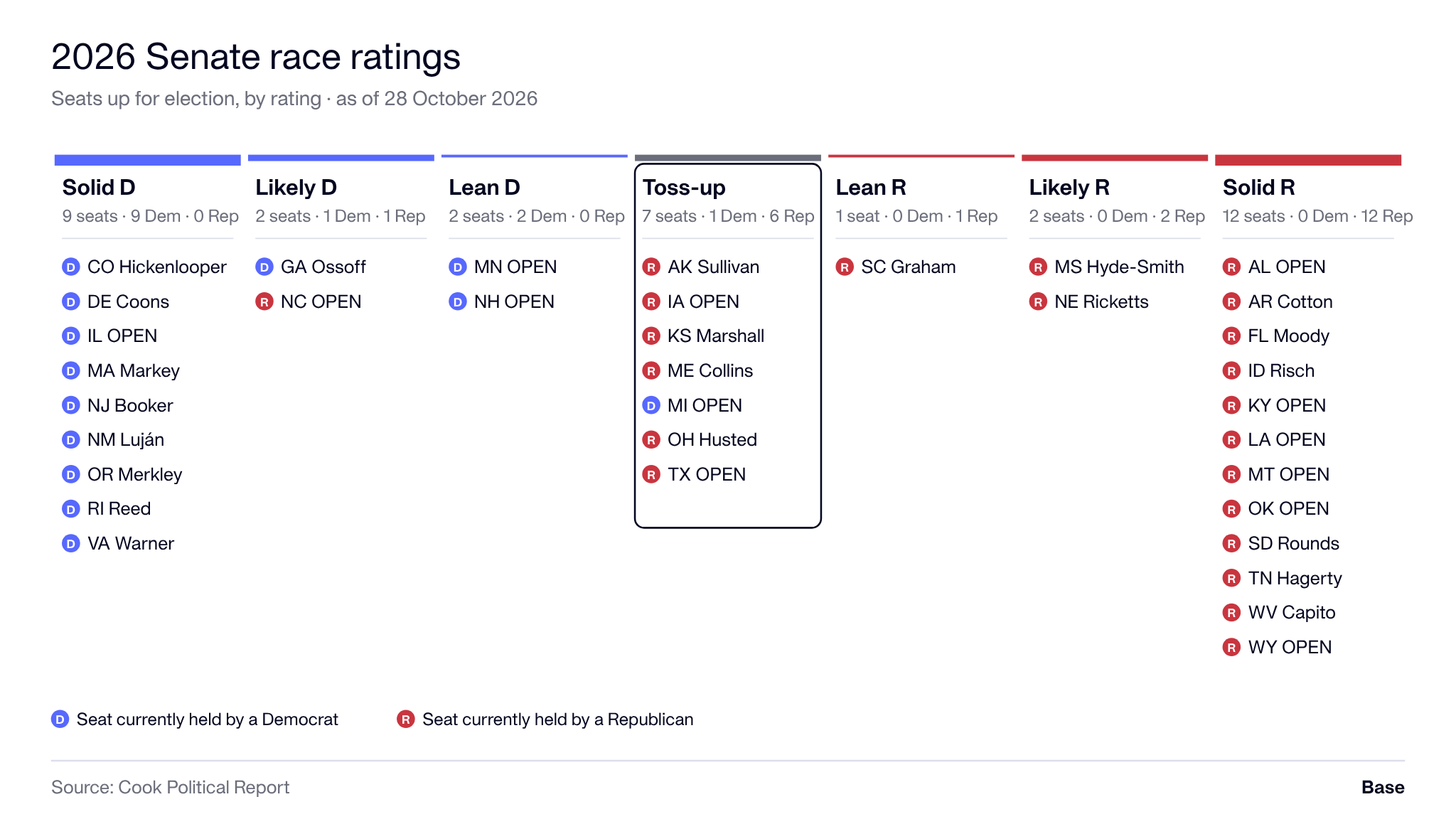
Of the races seen as a toss-up, Maine likely stands as the best opportunity for the Democrats to gain a seat, with incumbent Senator Collins being the only Republican incumbent running in a Democrat-leaning state. The races in Alaska and Ohio could also flip, while a Democrat victory in Texas, where Democrats last won a US Senate election in 1988, would be a seismic moment signalling a significant shift in US politics. Overall, the Democrats require a net gain of 4 seats to gain control of the Senate.
Looking to 2028
Once the dust settles on the midterms, the US political narrative is likely to move rapidly on to the 2028 presidential election. Clearly, a Democratic sweep would give the party considerable electoral momentum, while also providing a platform for the party to increasingly scrutinise President Trump’s policies over the final two years of his term.
On the other hand, the GOP retaining control of the Senate would be seen as validation of Trump’s political and economic agenda, which would likely lay the foundations for another MAGA-esque campaign into 2028.
That said, the next presidential election remains two years away, which is an eternity so far as politics is concerned. In addition, the 2028 election will be fought on the issues of the day at the time, while candidate selection - which is not yet even close to getting underway - will also play a significant role.